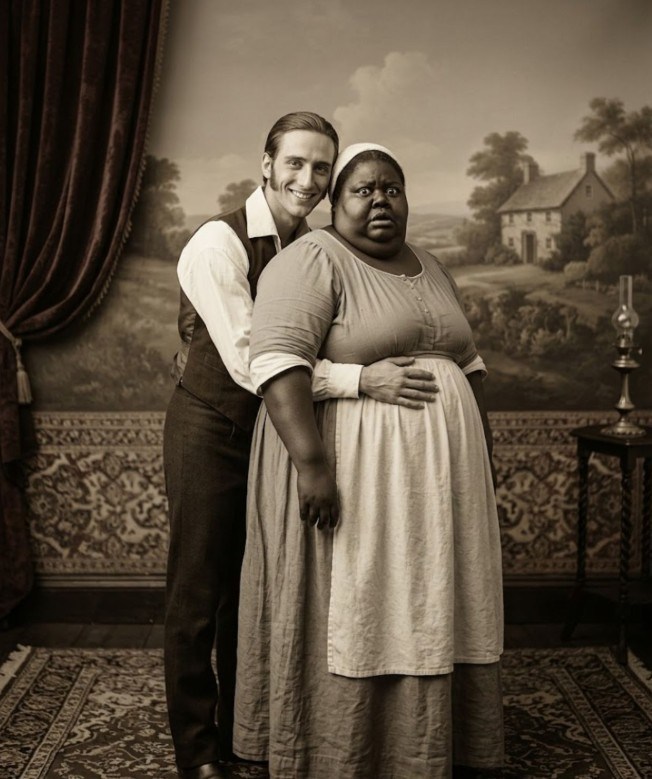
He explained to her that he didn’t want to hurt her or send her to the fields. He had another plan, but he needed her to trust him a little, at least for tonight.w
He then told her his story. Ten years earlier, he had had an only son, Vicente, an intelligent and courageous boy. One day, on their way back from the city, they were attacked by bandits. Vicente tried to defend his father and was stabbed in the chest. He had died in Joaquim’s arms.
Three years later, Joaquim’s wife died of fever. He remained alone, with his land, his pain and a debt of 12 contos de reis to Baron de Araújo, the most powerful man in the region.
If he didn’t pay before the end of the year, he would lose the property.
Baron de Araújo’s tournament
Joaquim then explained the opportunity that could change everything. The baron had a daughter, Eduarda, aged twenty-two. Unlike other women in her community, she loved riding horses, hunting, fighting and betting.
Every year, she organized a tournament on her father’s property. Fighters from all over the region came to compete: boxing, freestyle wrestling and other forms of combat. The winner won 100 contos of reis.
This sum would be enough to pay Joaquim’s debt, restore the quinta and allow him to hold on for years.
But Joaquim didn’t know how to fight. He was old, weakened, with no real luck.
He then told Benedita what he had seen in her: not a useless woman, but a fighter. A force that no one had been able to understand, because no one had ever given her the opportunity to use it for herself.
His offer was clear: he would train her in secret for the tournament. If she won, he would share the prize with her. Half would go to him, or 50 contos, enough to buy his postage and start again elsewhere.
Benedita asked what would happen if she lost.
Joaquim replied that they would lose together. He would lose the quinta. It could be resold. But at least they would have tried.
She didn’t trust him. Still, she didn’t have many other choices. Something in Joaquim’s voice, an honest fatigue and recognizable pain, made him think that maybe he was telling the truth.
She agreed, with a simple threat:
“I fight. But if you betray me, I’ll kill you. “
Benedita’s secret training
The next day, Joaquim woke Benedita before dawn. He took her to a hidden clearing, out of sight, and improvised a ring with ropes tied between the trees.
He brought sandbags for beatings, pieces of wood to break, and old books of fistfights that he had kept since his youth. He didn’t know how to apply all the techniques himself, but he knew the theory: positions, movements, dodges, attacks.
Benedita learned quickly. Her strength was raw, but she had instinct. It struck with the accumulated rage of twenty-three years of violence, chains, hunger and humiliation.
Little by little, this anger changed shape. It ceased to be a blind explosion. It became movement, precision, a controlled energy.
Every day, Benedita trained for five hours, then returned to work at the fazenda to keep up appearances. The months passed. His body strengthened, his movements became clearer, his posture more secure.
In September, three months before the tournament, Joaquim decided to test it. He stood in front of her for a simulation.
She knocked him to the ground in ten seconds.
Joaquim got up laughing, despite the blood in his mouth, and told him she was ready.
The December tournament
The tournament took place the first week of December. Baron de Araújo’s quinta was decorated as if for a party: colorful lanterns, garnished tables, live music. In the center, a wooden ring attracted all eyes.
Eduarda de Araújo, daughter of the baron, observed from the main lodge, dressed in red, her gaze lively and sharp.
When Joaquim arrived with Benedita, the laughter started again. This woman bought for almost nothing was going to face trained men. Nobody took her seriously.
Joaquim, however, paid the registration fees with his last cents.
The first fight pitted Benedita against a butcher from Barra Mansa, a 120 kg man with a thick neck and heavy fists. The crowd was betting on him.
Benedita entered barefoot, dressed in linen pants and a white shirt tied at the waist. No gloves, no protection. Only his body, his technique and the anger of a lifetime.
The butcher attacked. She dodged, turned the body and sent a hook up her ribs. The sound of the bone giving way echoed. The man fell to his knees, unable to breathe.
The second opponent was a capoeirista from Recôncavo, fast, agile and dangerous. He circled around her, repeated the sweeps and kicks. Benedita took it, observed, looked for the rhythm.
When she found him, she moved forward like a thrown force. One blow to the chin is enough to stop him.
The third fight was more difficult. His opponent, a former soldier in the Prata War, was technical, experienced and cruel. The fight lasted four minutes. He broke her nose. She broke three of his ribs and won on points.
In the final, the sun was setting. Benedita was bleeding and barely standing, but she was still there.
In front of her was Tomás, a huge man measuring 2.10 m and 150 kg, son of a human trafficker. He had killed six men in clandestine fighting.
Eduarda de Araújo came down to the ring and asked Benedita if she was brave or crazy. Then she added that she wanted to hire him if she won.
Benedita spat blood on the ground and replied: